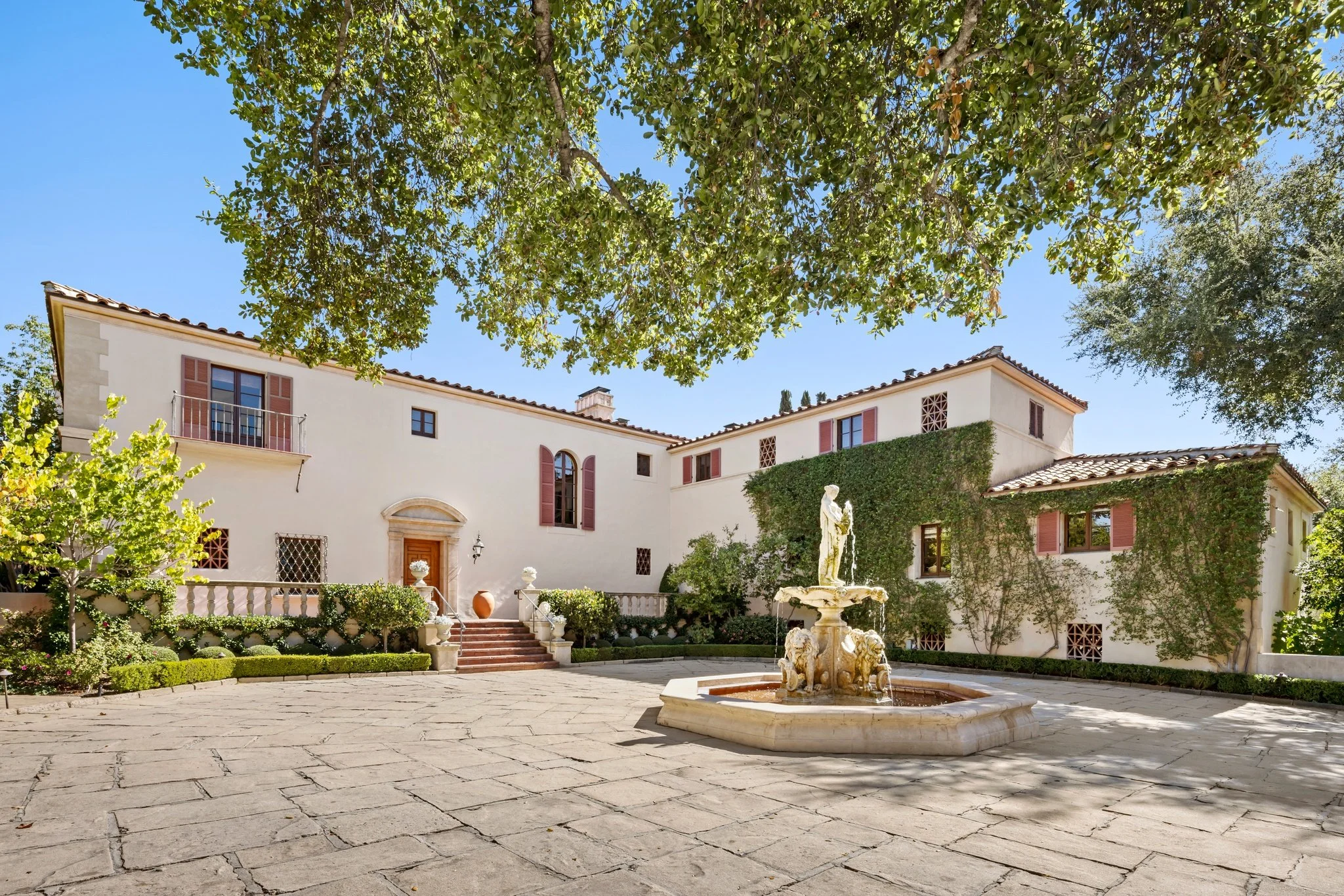

Pasadena
6 Beds | 11 Baths
10,918 Sq.Ft. | 2.71 Acres
The Frederick G. Adamson Estate, designed in 1927 by AIA Fellow Gordon B. Kaufmann is a defining example of Pasadena's Golden Era of architecture. This Italian Revival masterpiece is secluded beyond rolling lawns and mature landscape at the crest of a long, gated drive. The estate commands a premier setting along the western bank of the Arroyo Seco, on South San Rafael Avenue, one of Pasadena's most distinguished addresses. The 2.71-acre property is one of the few remaining undivided parcels on the street. Kaufmann's timeless vision reveals a residence that, while exceeding 10,000 square feet, retains a sense of warmth, intimacy, and effortless livability. Equally suited for grand entertaining or quiet retreat, the home exemplifies Kaufmann's celebrated ability to balance public and private realms while capturing the site's commanding views and sweeping panoramic vistas.
Commissioned by Frederick G. Adamson, a prominent industrialist, the estate reflects Kaufmann's architectural mastery, the same genius that produced Caltech's iconic Athenaeum, the Los Angeles Times Building, the Hollywood Palladium and more. Having only a handful of owners in nearly a century, the Adamson Estate endures as a landmark of rare craftsmanship and artistry.
Original details remain intact and meticulously preserved: lathe-and-plaster walls, hipped clay-tile rooflines, paneled walnut library, intricate moldings, oak floors, five fireplaces, and period light fixtures and hardware. Published in Architectural Digest (1930) and featured in numerous film and editorial productions, the residence is bathed in natural light and Arroyo breezes through perfectly placed French doors and windows. A succession of terraces, balconies, and loggias extends the living environment outdoors, seamlessly uniting the interior and exterior living spaces. Gated and enveloped by park-like grounds, the estate's secluded approach sets the tone for its grandeur. Just south of the Colorado Street Bridge and minutes from Downtown Los Angeles, Burbank studios, Caltech, and the Huntington Library & Gardens, the Frederick G. Adamson Estate remains an enduring and peerless expression of architectural significance, privacy, and timeless Pasadena elegance.
The Garden & Grounds
Like The Huntington and Descanso Gardens, this magnificent landscape features the same winning combination of large, native coast live oak (Quercus agrifolia) specimen trees underplanted with camellias (Camellia japonica) and azaleas (Rhododendron spp.). Many beautiful specimens of locally bred camellias and azaleas can be found throughout the property, along with productive citrus trees, flowering subtropical trees, olive trees (Olea europaea), magnolias (Magnolia grandiflora), mock orange trees (Philadelphus spp.), and more—all crowned by the lofty overstory of 27 mature fan palms (Washingtonia robusta). Southern California at its best.
The large southern magnolia (Magnolia grandiflora) at the base of the front lawn is a stunning specimen and a showstopper when in bloom during summer. To its right stands a lovely pink trumpet tree (Tabebuia rosea), which bursts with pink flowers in spring before its leaves emerge—spectacular when in bloom. The jacarandas (Jacaranda mimosifolia) pick up where the tabebuias leave off, carrying the garden into summer. There is always something blooming in this intricate yet park-like estate garden.
At the base of a magnificent strawberry tree (Arbutus unedo) growing within the palm grove, one finds a large stand of jeweled chain fern (Woodwardia unigemmata). This highly desirable and uncommon fern is truly remarkable in such abundance and provides the perfect understory for the elegant palms.
Three Italian cypress (Cupressus sempervirens) trees provide vertical structure in the pool area, while three more strawberry trees frame the views toward the San Gabriel Mountains and the Arroyo.
A private hiking trail winds through the upper portion of the Arroyo slope, looping through an oak woodland now being restored to native plants exclusively. Along the way, one can enjoy a grotto and several picturesque lookouts.